Showing posts with label dungeness. Show all posts

Friday, 20 February 2015

Birding All Around


It's been a strange few weeks, applying for jobs and not knowing quite what the future holds. It is all resolved now, and we are back to The Farnes for another season. Along the way, we have managed some top quality birds.
A while back now, we took our annual pilgrimage to Dungeness to catch up with the winter wonders that inhabit the wilderness of the peninsula. All the usual suspects were present, with Great Egret, Smew, Bearded Tit, Marsh Harrier and Tree Sparrow showing off nicely. Undoubtedly the highlight was sitting in the Scott Hide and watching a Kingfisher and sublime Male Smew fishing within metres of us. It was great to be able to catch up with the two Cattle Egret that have been resident all winter and the local Tundra Bean Geese at Scotney and Lesser Yellowlegs at Rye Harbour.

It's always a treat to observe these birds properly! Splendid Kingfisher

The most handsome duck of all? Smew

Cattle Egret, without cattle this time.

Having been able to also catch the Greater Yellowlegs at Titchfield a few weeks before, I believe I am now in real contention for the two worst record shots of Yellowlegs in the country this year. A prestigious title that I have long wanted to add to my collection.... Luckily the scope views of these smart American waders were much much better than the photographs suggest.

Greater Yellowlegs....

And Lesser Yellowlegs... Honest Guv
 
And now to fast forward a tad, and a trip to Northumberland for the Farnes interview via Devon to visit friends. What a beautiful part of the world, and we had a wonderful guided tour of the coastline, adding some more top quality birds along the way. Our first stop was Darts Farm RSPB, where you could be forgiven for thinking that the three Penduline Tit there were escapees and not bothered by human presence. Certainly the most enjoyable life tick I have had in a long while. These smart little birds are becoming increasingly regular, and they are certainly a contender for the next species to establish themselves as British breeders.

Cracking little Penduline Tit
Another target species for us both was Cirl Bunting, a bird I had never seen before due in part to the fact I had never visited that part of the Devon coastline before. This is a species that represents both the tragedy of our relentless drive to destroy as much of our countryside as possible for profit (mainly animal products), and also what can happen if conservationists and local landowners take action. Watching two males happily singing away was a strange experience, appreciating the beauty of these now rare (in British terms) Buntings and also wondering which species will be next to suffer in this way. When will people listen.....

Cirl Bunting, unaware of its own plight?
Along the way, we were also treated to spectacular views of this rugged coastline. This photo was taken in very windy conditions from Prawle Point, the most southerly point of Devon. Despite the wind, a cracking male Stonechat was clinging on to a piece of Gorse. We also stopped by the very obliging Snow Bunting that has been present for some time now on the sea wall at Turf in the Exe Estuary.

Delightful. Snow Bunting

Not a bad place to live!

And last but not least, two winter stunners that are much easier to catch up with on the East Coast than down in Sussex where I reside at this time of year. As we were in Newcastle, it would have been very rude not to make the most of seeing both Waxwing and Shore Lark, two birds that attract me for their beauty more than anything else (as I'm sure is the case for most people). Both were showy, the Waxwing at The Lea's in South Shields and the Shore Lark on Hartlepool Headland. The Shore Lark was in a particularly grotty area; obviously the food was good and the constant stream of dog walkers and the view were not enough to put if off!

Yet another gorgeous bird! Waxwing

And another... Shore Lark
So after a whirlwind few weeks its off to explore La Palma and its endemic subspecies for us next week! And then its back to the mayhem of the Farnes for another season. Could be worse.....

Friday, 7 February 2014

End 2013.... Begin 2014


A bit late I know, but this is how 2013 ended and 2014 began in bird-terms for us. It ended very nicely, with a trip along the coast taking in Purple Sandpipers at Southsea Castle, the Ring-billed Gull at Gosport then the Lesser Yellowlegs at Lepe (on the second time of asking). The Purple Sands showed as well as they usually do, down to a few feet at times in the lovely morning sun. The Ring-billed Gull was also very obliging, posing nicely on the path for a few minutes of close observation before flying off into the depths of Gosport; good timing we thought! However, the same could not be said for the Lesser Yellowlegs, which insisted on staying on the far side of the pools at Lepe CP for the whole time we were there, and unfortunately a long drive to Scotland meant we had to depart with distant but very satisfying views.

Purple Sandpipers at Southsea, Calidris maritima

Ring-billed Gull showing very nicely the chunky bill with clear black "ring", pale iris and winter streaking.


Ring-billed Gull, Larus delawarensis

Worst record shot ever? Lesser Yellowlegs, Tringa flavipes

Then into 2014, which began for us in Scotland where Grey Wagtails, Ravens and Goosanders were a plenty, and through the gloom a stunning Kingfisher along the river where we stay.

Kingfisher, Alcedo atthis

Then back to the south coast before heading back to Norfolk. And this meant we had to make a trip to Hove to see the Grey Phalarope, which will be hard to beat this year. Despite not being the rarest of birds, the views were incredible as it made its way happily around a children's paddling pool, and it will live long in the memory. Also nearby where the Red-breasted Mergansers at Widewater Lagoon, showing some early signs of displaying, although the female on the left in the photo below seems more interested in escaping with her weeds.

Grey Phalarope, Phalaropus fulicarius

Grey Phalarope, Phalaropus fulicarius

Red-breasted Merganser, Mergus serrator

And finally for this post, a an always enjoyable trip to Dungeness to visit Lana. I love this place, and as usual it delivered the goods, with Great White Egret, Black-throated Diver, Smew, Little Gull, Kittiwake and a host of other wonderful birds on display. Perhaps the most satisfying find was this 1st winter Glaucous Gull, as we had spent many mornings looking for it, only to find it on my last day flying right in front of us. By the time I had my camera out, it had finished hovering in front of us with a fish in its beak and was flying away,but I still managed this shot showing the hefty pink bill with black tip and complete lack of black or dark brown in the primaries.

Glaucous Gull, Larus hyperboreus


Sunday, 27 January 2013

The Yearly Pilgrimage!


So, the yearly trip East to Dungeness was undertaken on Friday, with great success and no disruption from bad weather! Starting off on the beach by the fishing boats, there were c10 of both Gannet and Kittiwake feeding close in-shore, giving fantastic views. They were also in the company of 100+ auks, split evenly between Razorbill and Guillemot, with equal number passing by in the 10 minutes we spent watching. There was also a passage of around 40 Red-Throated Divers, and the Glaucous Gull was present as usual.

 Glaucous Gull, Larus hyperboreus with Herrings, Larus argentatus and a single Great Black-backed Gull, Larus marinus

Northern Gannet, Morus bassanus

Then onto the ARC pit, where the water level was very high, much like the rest of the reserve. On the walk down the Tree Sparrows could be heard from across the road and a few Fieldfare and Redwing were present, as was a singing Cetti's warbler in the reedbed. From the hide, we were afforded great views of a male and female Goldeneye, and a Kingfisher put in a flyby.

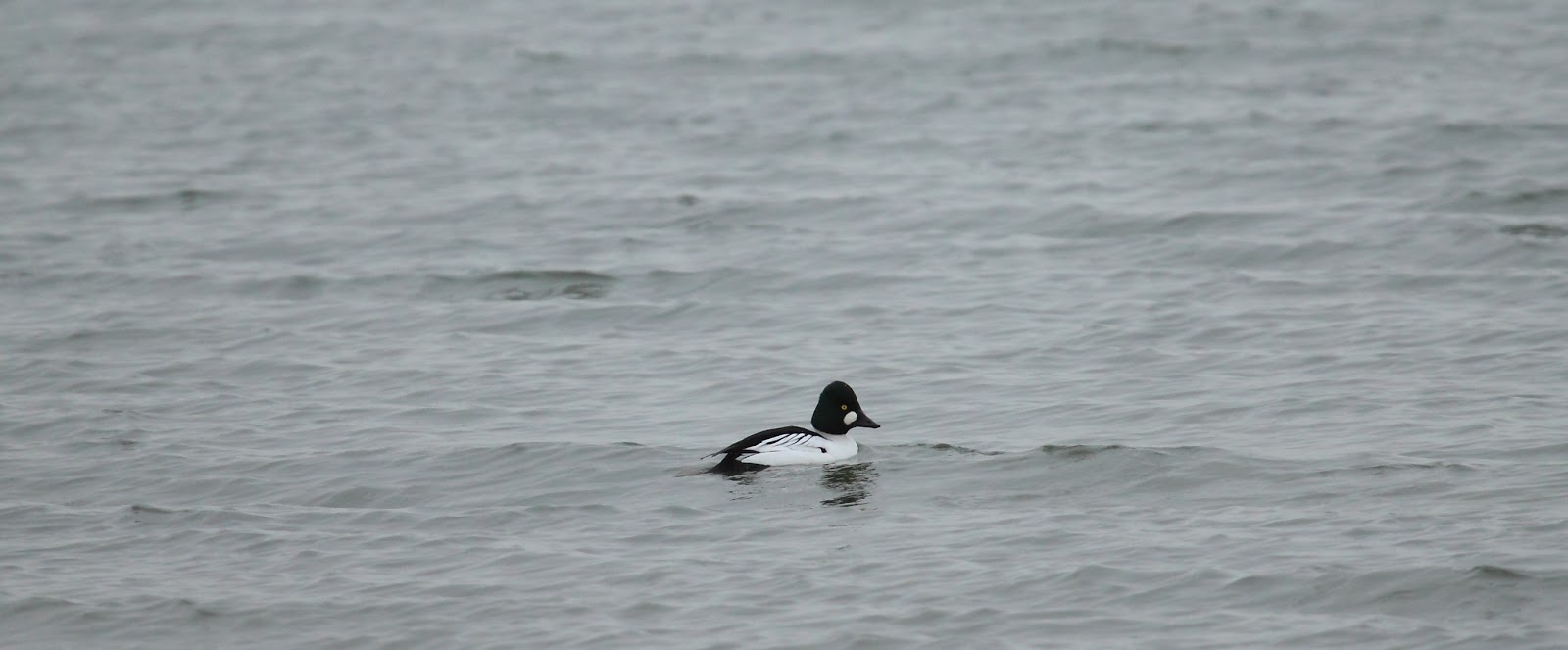
Goldeneye, Bucephala clangula

Onto the main reserve, and there were hundreds of Fieldfare with Redwing and Song Thrush mixed in. On the drive down, a Peregrine was plucking a Wigeon while being hassled by two Marsh Harriers and some Crows and 8 Barnacle Geese were grazing in a field. From the Dennis hide, the first of 3 Great Egrets of the day flew past, and a stunning Male Smew landed in front of us with a female and spent a few minutes swimming around before flying off again. On New Diggings, another Marsh Harrier spent a good 5 minutes attempting to catch itself a Coot, and nearly succeeded before eventually giving up. Around the rest of the reserve, there were Lapwing, Teal, Tufted Duck, Wigeon, Gadwall and Shoveler in good numbers. There were also singles of Grey Plover, Chiffchaff, Skylark, Little Grebe and Woodcock and two more Great Egret.

Great Egret, Ardea alba

Chiffchaff, Phylloscopus collybita

After half an hour warming up in the car/eating lunch we moved onto Rye Harbour where a chilly walk produced lots of Oystercatcher, Dunlin, Grey Plover, Turnstone, Teal and Sanderling, a single Black-tailed Godwit and an Avocet that was feeding on the wader pool.


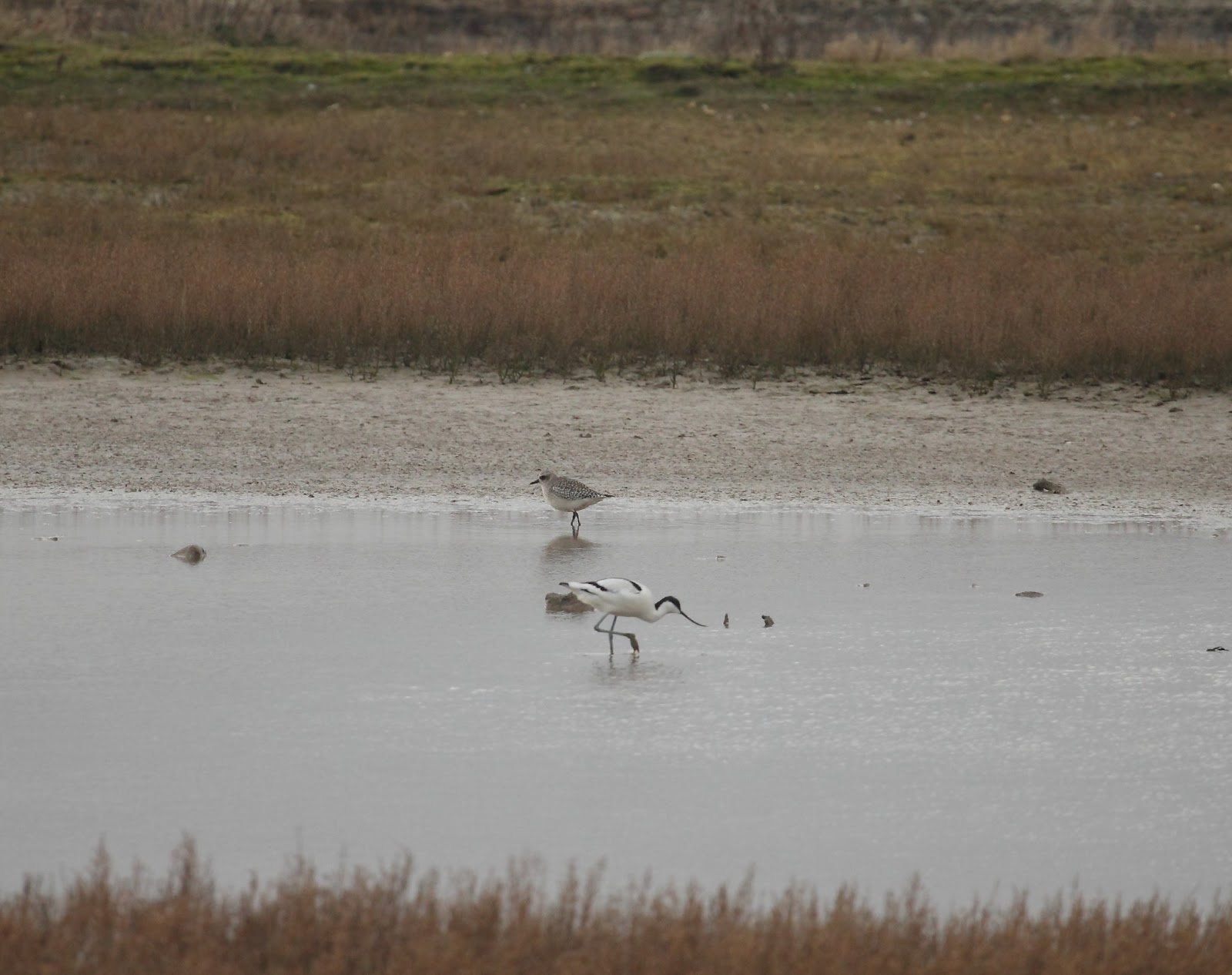
Avocet, Recurvirostra avosetta and Grey Plover, Pluvialis squatarola

 On Flat Beach there was a lovely Spotted Redshank which gave close views while feeding around some sleeping Snipe. There was also a surprise sighting on the beach in the form of a lone Grey Seal which seemed very happy resting amongst some gulls. On the return walk around 70 Curlew flew over and landed in the marshy area of the reserve.

Spotted Redshank, Tringa erythropus

Grey Seal, Halichoerus grypus
On the way back and in seriously fading light, we stopped at Pett Levels briefly where a large flock of Canada Geese had been joined but roughly 15 White-fronted Geese and a single Bar-headed Goose, taking the species total for the day to a relatively impressive 73!