Showing posts with label fair isle. Show all posts

Tuesday, 25 September 2012

Fair Isle Finale


Well this will be my last post from Fair Isle (actually being done retrospectively at home). What an amazing experience, although it does seem that I left a few days too early; needless to say I was more than gutted when I saw what had turned up on Sunday. That is not to say that I didn't see some amazing birds, it just means I'll have to go back! So here are the last few pictures I took there, including my first Marsh Warbler, Skylark, Whinchat (in the hand) and a rather rare and tiny eastern Grasshopper Warbler; its' wing length was 3mm below the range of that of our resident Grasshopper Warblers.

Marsh Warbler, Acrocephalus palustris

Skylark, Alauda arvensis

Whinchat, Saxicola rubetra

Common Grasshopper Warbler, Locustella naevia
 

Sunday, 16 September 2012

Why is There a River in the Garden?


With some fairly heavy spells of rain over the last few days, a river was probably more likely than the bird that was trapped in the nets a few mornings ago! Having had almost constant westerly winds for the past week, we weren't expecting much in from the continent, so you can imagine the excitement when a visitor came running into the ringing room this morning, trying to explain through his excitement that there was an unstriped Locustella in the nets, and that he was certain that it was a River Warbler. That is indeed, what it turned out to be!
This little bird breeds in Eastern and Central Europe then migrates down to East Africa, so how it had managed to battle through the winds and end up here is a mystery. What makes it more special is that it is Fair Isles' second record of the year.


River Warbler, Locustella fluviatilis


River Warbler, Locustella fluviatilis. Picture by Will Miles


River Warbler, Locustella fluviatilis and me (not sure what the face is all about). Picture by Will Miles.
 I also managed to finally catch the Mealy Redpoll that has been hanging around the obs for the last few days. This was a first for me in the hand, and it was a lovely fluffy individual, looking like it has come from somewhere rather more cold that Fair Isle!!


Mealy Redpoll, Carduelis flammea rostrata


Sunday, 9 September 2012

Finally, a Piece of the Action!


So the strong westerlies that have been sweeping the country over the last few days has brought in all manner of American waders to UK shores, and we were beginning to wonder if we were going to get in on the action at all. Luckily, yesterday we did as A Buff-Breasted Sandpiper turned up on the South of the island. The bird remained and we easily twitched, giving superb views, sometimes at very close range. The Buff-Breasted Sandpiper breeds up in the tundra of North America and winters in South America, making it a very long distance migrant. It is one of the commonest American waders to visit our shores, but none-the-less it is still a lovely little bird. This lover of short grasslands was first found on the island "golf course."

Buff-Breasted Sandpiper, Tryngites subruficollis. With juvenile Ringed Plover, Charadrius hiaticula

On the same day, we were also joined by c1000 Pink-Footed Geese seeking shelter from the fog. These noisy migrants could be heard all over the north of the island for the day, before most of them left last night. It was quite something being up on the hills during census and having a flock of 800 passing at virtually eye-level. This photo is of one of the smaller flocks, containing roughly 130 birds.


Pink-Footed Goose flock, Anser brachyrhynchus

I woken up again this morning by Will, this time offering me a Sparrowhawk as a ringing tick. Needless to say that I was very cautious when first given it, but it was amazing to have such an impressive predator in the hand!


Sparrowhawk, Accipiter nisus


My quest for the ever growing population of Lapland Buntings on the island continues, having bottomed out no less than four times when trying to see one!

More Musings From Fair Isle


South Lighthouse, Fair Isle

A nice picture of the South Lighthouse to start this post off. A few birds have started arriving in the last few days with Grasshopper Warbler, Sedge Warbler, Red Breasted Merganser and Knot all being added to the list (this is being written retrospectively, there are some exciting birds here at the moment!). In the mean time, our attention has turned to fungi and this rather scarce plant! This is Oysterplant, Mertensia maritima. It gets its name due to the fact its leaves taste like oyster, but having never tried oyster I can't comment. It is rather pretty though, and Shetland is an important site for this declining beach-loving species. Its seed can be spread via the sea so it can colonise new beaches readily, however grazing and disturbance often means these new colonies are unsuccessful.

Oysterplant, Mertensia maritima

Our second Arctic Warbler of the season (possibly third) is still showing well in one of the crop strips, so I was able to grab some nice shots of it.


Arctic Warbler, Phylloscopus borealis


Arctic Warbler, Phylloscopus borealis
 

Saturday, 25 August 2012

A Suprise Wake-Up Call!


With things still fairly quiet on the island and the weather not looking like it was going to help change that, a few lie-ins were in order after a stint of Storm Petrel ringing. However, yesterday it was rudely interrupted by a knock at the door.... Will, one of the AWs said that he had a new ringing tick for me, so half asleep I made my way to the ringing room. As I walked through the door I passed an Icterine Warbler going the other way, and my though was "that's the prize bird, I'm guessing I'll have a nice scarcity!
However, I was handed a large warbleresk bird and happened to glance down to where the bible (collins bird guide) lay open on a page that contained Nightingale. What I didn't register is the bird underneath it.... a Thrush Nightingale. I glanced at the bird in my hand and my exact words were.. "bloody hell!" This is a rare bird in Britain, and I was being given the chance to ring it! The Sprosser, in German, is the Northern and Eastern European equivalent of our own Nightingale. Needless to say I was rather chuffed.
Thrush Nightingale, Luscinia luscinia

Thrush Nightingale, Luscinia luscinia
After that wonderful start to the day, another two Icterine Warblers were found. At one point in the afternoon, the obs garden (no bigger than 30 square metres) contained Thrush Nightingale, Icterine Warbler, Barred Warbler, Whitethroat, Lesser Whitethroat, Reed Warbler, Willow Warbler and Siskin, not to mention the resident Twite on the feeders next to it!

Today has also been fairly quiet, with a strong northerly wind blowing up making it a little chilly outside. However, a single Citrine Wagtail has been reported, and this simply stunning juvenile male Crossbill was trapped at lunchtime.

Common Crossbill, Loxia curvirostra

Thursday, 23 August 2012

A Break From Birds?


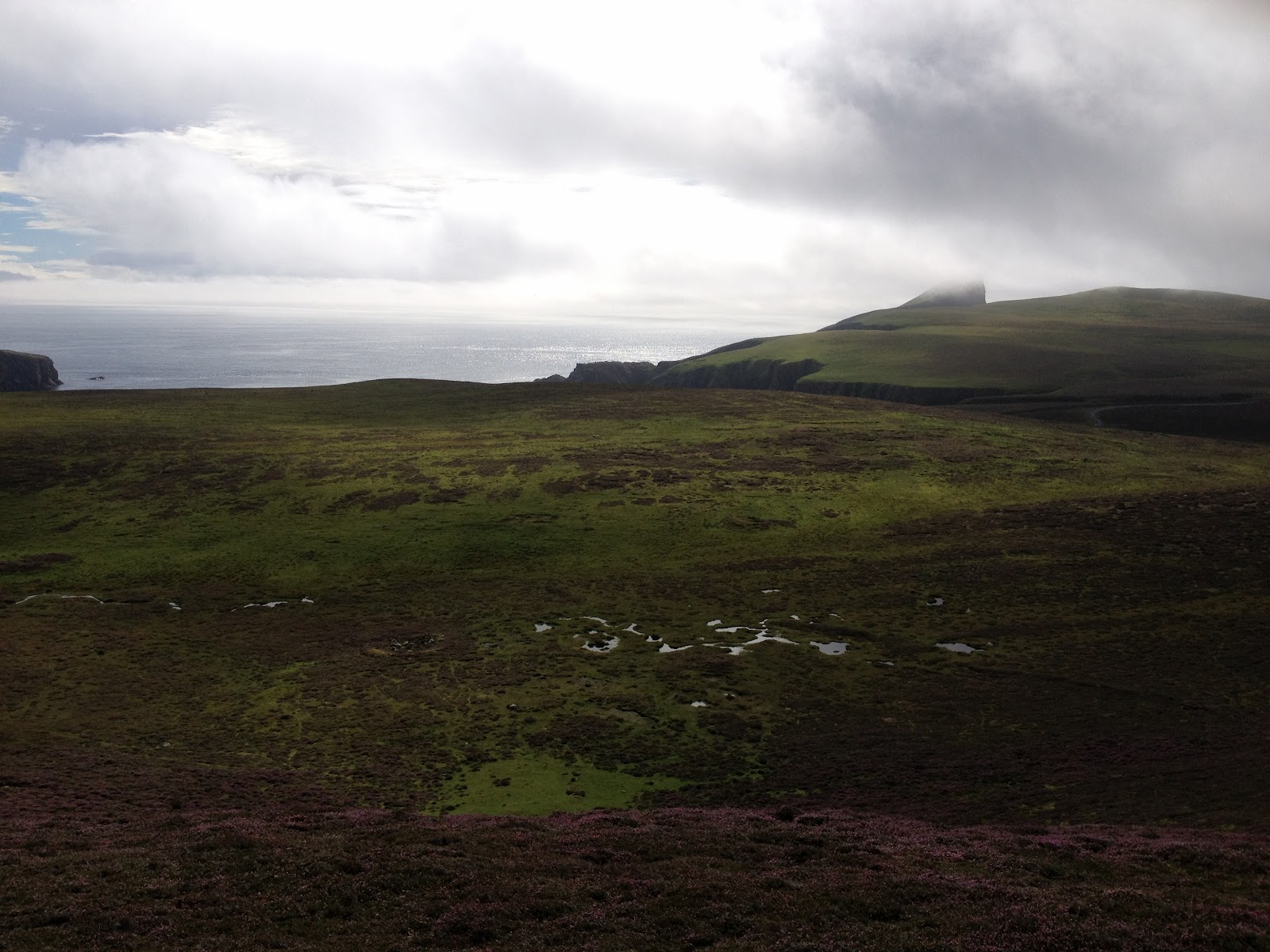
Well not exactly. There is never a break from birds here. However, things have quietened down over the last few days, with excitement being provided by a Shoveler on the wader pools outside the obs and the largest flock of Shelduck seen on Fair Isle for 40 years...... 6! There have been lots of cetacean sightings over the last few days, and I was lucky enough to catch sight of 5 White-Sided Dolphins yesterday and a pod of at least 10 White-Beaked Dolphins this morning, on what I can safely say is one of the flattest seas I have ever seen, simply stunning! A trek over the heath on the north of the island to survey Bonxie chicks gave me an opportunity to get some pictures of the island itself! This first picture is of the obs looking across the Havens (where we ring the Storm Petrels) from North Buness, where the Puffins and Arctic Terns normally nest in the summer.

Fair Isle Bird Observatory

This next photo is taken from Swey, in the heart of the North and looking over Homisdale! This is a Bonxie stronghold and it can get interesting if you venture too near them. Although they do come at you at some pace, they very rarely make contact!


Looking East

Fair Isle Air Strip

This final photo is me getting a bit arty with some heather! Not bad for a photo taken on a phone!


Arty heather


Tuesday, 21 August 2012

An Arctic Rarity!


So this is a rather special post, but before we get to the real excitement, I took this nice photo of a Raven making a racket on top of North Light yesterday, just after I found my first BBRC rarity!!

Common Raven, Corvus corax

An Arctic Warbler! Keep an out next October, I'll be getting my name published in the annual report (hopefully!). This stunning little bird was flitting around Kirn O'skroo on the north of the island! I knew it was either an Arctic or Greenish Warbler, but on return a few hours later with a small army of experienced birders it was confirmed as the Arctic Warbler, Fair Isles' 80th record and only the second bird in the UK this year! This bird breeds right up in the northernmost forests of Scandanavia (Fennoscandia) and Russia and winters in SE Asia; meaning it has one of the longest migration routes of any Old World insectivorous birds.


Arctic Warbler, Phylloscopus borealis


Some of the assembled birders. Joe, Me, Jason and Becky.

I also got another treat yesterday morning when Jason caught a Common Rosefinch in one of the heligoland traps. This was the first time I'd seen one of these nice little birds anywhere near close and was a nice start to the morning, on a day which also produced a Little Gull at South Light and a nice flock of 20 Whimbrel that flew past us while we were on the cliffs.


Common Rosefinch, Carpodacus erythrinus


Common Rosefinch, Carpodacus erythrinus


Friday, 17 August 2012

A dark and stormy night.....


Well it was dark, but not stormy in the conventional sense! Last night, at around 11:30pm, in pitch black, we headed down to the coast for a night of Storm Petrel ringing.... I can't tell you how excited I was! The nets were set up before it was dark and our makeshift ringing station (generator room) organised. So the nets were unfurled and the tape turned on to attract any passing birds. Within seconds we had four birds in the net. And this was a sign of things to come. In just under four hours we rang 120 Storm Petrels! It was quite incredible.
What is more incredible is the life of these little birds. Not much bigger than a sparrow, these birds are pelagic, spending over half their lives at sea of the coast of South Africa, a life by the way which can be 40-50 years long! They only come onto land to breed and this is a precarious business for a Storm Petrel as they are less than useless on hard ground, hence why they only leave their nest sights at night; burrows or deep crevices in rocks out of the reach of predators such as skuas. As can be seen in particular in the bottom photo, Storm Petrels have beaks very similar to those of the Fulmar, allowing them to be able to extract the salt from sea water.


European Storm Petrel, Hydrobates pelagicus

European Storm Petrel, Hydrobates pelagicus

Monday, 13 August 2012

And now for the migrants


The migrants have been trickling slowly through over the last few days, with Crossbill, Chiffchaff, Willow Warbler, Ruff, Dunlin (which we were trapping today), Green Sandpiper and Golden Plover all logged on the daily census! There have also been a few stand out birds so far, and two lifers for me! A Sooty Sheerwater on the ferry over was a first for me, and a Wood Warbler provided an excellent start to my stay here yesterday. Today's two birds have to be my favourite so far, one in the form of a Pied Flycatcher, and the other in the form of an Icterine Warbler, my other life tick so far! Rain is forecast for tomorrow, which bodes well for a potential fall of migrants on Wednesday!


Dunlin, Calidris alpina

Wood Warbler, Phylloscopus sibilatrix
Pied Flycatcher, Ficedula hypoleuca


Icterine Warbler, Hippolais icterina


First update from Fair Isle


So I've been on Fair Isle for two days, and I'm already in love with the place! The wild and rugged landscapes are simply stunning, and the birds have been equally as wonderful. The island is populated with Skuas, both Arctic and Great, as well as Wheatear, Meadow and Rock Pipit, Fulmar, Snipe, Twite and many others at this time of year!


Great Skua, Stercorarius skua


Great Skua, Stercorarius skua


Arctic Skua, Stercorarius parasiticus,
 pale and intermediate morph displaying


Arctic Skua, Stercorarius parasiticus


From this......


To This..... Fulmar, Fulmarus glacialis


Twite, Carduelis flavirostris