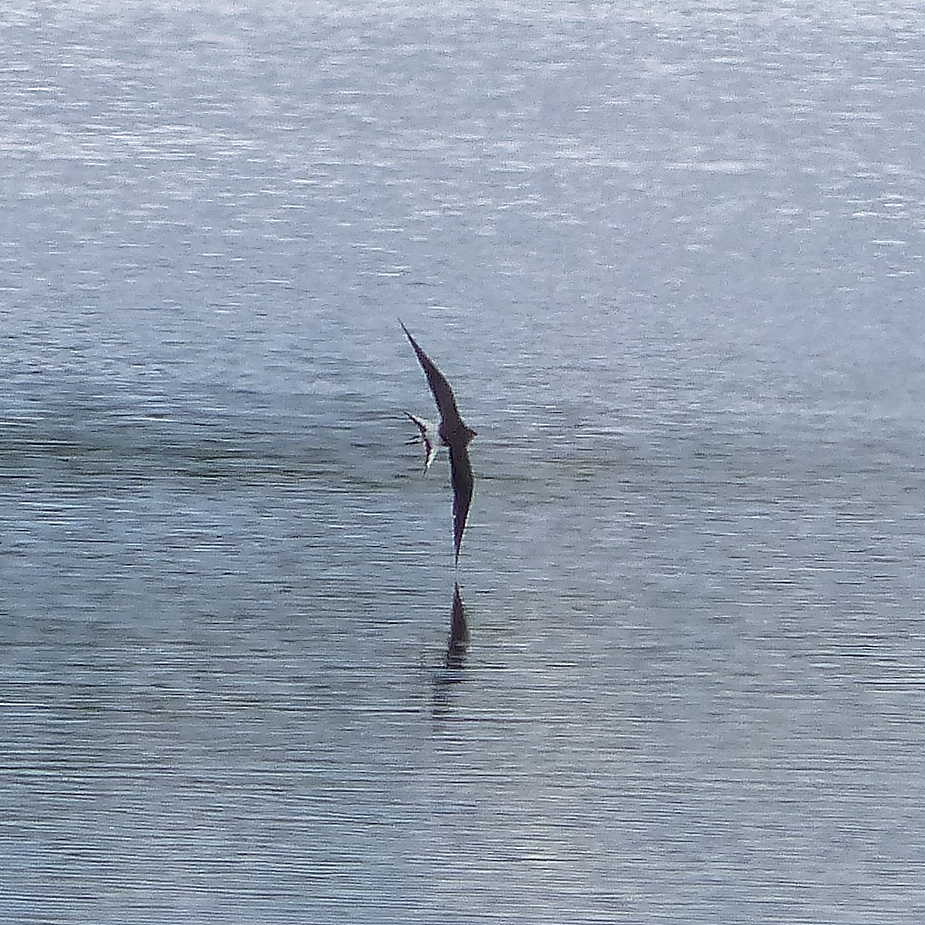
A lot happens in a month on the Farnes, especially at this time of year. The only thing that hasn't changed appears to be the weather, as the sun refuses to shine for long and westerly winds persist; enough to drive any rarity-hunter to distraction at this time of year. Luckily this week the Black-winged Pratincole at Bothal brought some very welcome relief from this spell without rares. I managed a few poor "record shots" but to be honest I was more interested in enjoying this majestic bird as it put on a real show for the gathered crowd, flying within 20 metres of us at times. My first Pratincole...
 |
| Black-winged Pratincole at Bothal; a fabulous fabulous bird. |
A BWP arriving on the Farnes at this time of year would have some competition for attention though, as all our resident species are present in maximum number and we have plenty of chicks around as well. Cute vs Rare. Our Shag chicks are by far and away the most developed, exactly as we would expect. Some are already looking too big for the nest, and it will be a busy period ahead for the parents of all these hungry mouths.
We now also have Kittiwake, Razorbill and Guillemot chicks emerging, and fresh batches of Eider ducklings appear every day. While eggs are still dominant, it won't be long before that trend reverses, and all our birds will be busy feeding up their chicks, readying them for their first trip out to sea. One sign we eagerly await at this time of year is Puffins bringing in Sand Eels, which can only mean one thing... PUFFLINGS a serious contender for the Farnes most adorable chick. Then again, the competition is very stiff.
 |
| If that isn't cute, I don't know what is. Puffling. |
 |
| Staying low for now, it won't be long before these little guys are off to sea! |
Without doubt the species with the most "presence" on the islands are the Arctic Terns. For the the next few months our home becomes theirs and life very much evolves to fit in around these magnificent birds. A majority of them are now down on eggs and in a few weeks we will begin to find the newest generation of this truly remarkable species. It never ceases to amaze me when I walk around the islands that by the end of this year, some of these birds (currently tiny eggs) will be somewhere in the Southern Hemisphere, most likely off the coast of Australia or the Antarctic pack ice. This species experiences more daylight hours than any other animal on the planet. It's not all about the Arctic Terns though. We have our colony of Common and Sandwich Terns all now on eggs as well, and we expect to see chicks from them soon too.
 |
| A typical Arctic Tern nest |
 |
| And a typical view of an Arctic Tern on Inner Farne |
On Inner Farne recently have also been the usual pair of Roseate Tern that grace the islands at this time of year. They display, even copulate, threaten to breed and then disappear. Every year we keep our fingers crossed that they will stick around to breed again.
 |
| Two Roseate with an Arctic Tern getting involved too. |
It's not all about the seabirds on the islands either. Hopefully it's third time lucky for a pair of Ringed Plover on Inner Farne, and this time they've chosen the beach near to the Arctic Terns. This time we've got in early and put a cage over the eggs to keep them safe from predators, but still allow access for the Ringed Plover. We have also ringed the first Pied Wagtail chicks of the year, and it won't be long until they'll be out and about and exploring the islands.
 |
| Ringed Plover amongst the beautiful lichen that covers the rocks around the islands |
 |
| Wonderfully camouflaged Ringed Plover eggs (although sometimes not enough) |
 |
| Looks nice and cosy in there |
And finally, believe it or not it's no always about the birds. As we were getting a lift back out to the islands after our day off, a sharp-eyed visitor spotted a fin. It turned out to be around 15 split between two pods of Bottlenose Dolphins. They we simply wonderful to watch, jumping clean out of the water and swimming right along side the boat. As we edge into summer sightings will become more and more frequent.
 |
| Lana kindly pointing the Bottlenose Dolphin out! |
This week marks the start of what is perhaps the busiest two weeks of the year for us. Cliff counts were due to begin on 1st June, however yet more strong winds have meant that so far we have been unable to get out. The birds here seemed to have faired okay in the storm-like conditions of the last few days, but we won't truly know until we are out and counting. Somewhere in between the 10 counts we do, nest count day. This is as it sounds; we meticulously walk the islands that contain breeding birds and count every single nest. Once the counts are all in we will have a much better idea of how numbers are doing this year. I hope to be back writing on Sunday about the lovely fall of migrants that we may or may not receive on Friday with easterlies forecast. However every time I check the forecast they seem to decrease in strength and duration. This is surely our last chance to get a nice scattering of Spring scarcities, and if it doesn't happen then all attention will be focused on late June, when hopefully our special guest will return for the third year in a row.....